This is the home page of the Flexible Design Methodologies for Application Specific Processors (FlexASP) project at the Department of Pervasive Computing of Tampere University of Technology (TUT). Currently, the project's main research focus is on the Transport Triggered Architectures, and on codesign toolset issues.
News and updates
January 21st, 2013: TCE 1.7 released
A new version of the toolset is now available for download.
See the release announcement for details.
Jan 9th, 2013: Master's thesis added: "Floating-Point Arithmetic in Transport Triggered Architectures"
A new Master's Thesis about floating-point support in TCE has been added to the publications section.
Nov 13th, 2012: A doctoral dissertation added: "From Parallel Programs to Customized Parallel Processors"
The doctoral dissertation of Pekka Jääskeläinen is now available in the publications section. The dissertation is about exploiting parallel programming languages in the parallel processor customization, and expanding the customization aspects to the multicore level.
June 7th, 2012: TCE 1.6 released
A new version of the toolset is now available for download.
This release adds support for LLVM 3.1, experimental Verilog backend for the Processor Generator, support for explicit access to multiple address spaces from C, a simplified C++ interface for accessing the simulation engine, automated generation of clustered-style TTA machines, experimental vector input and a bottom-up instruction scheduler. See the CHANGES file for a more thorough change listing.
May 12th, 2012: ASILOMAR '11 publication added
We presented a paper about our operation description format and compiler retargeting:
- Heikki Kultala, Pekka Jääskeläinen, Jarmo Takala
"Operation Set Customization in Retargetable Compilers".
Forty Fifth Asilomar Conference on Signals, Systems and Computers (ASILOMAR), 6-9 Nov 2011, Pacific Grove, California (IEEEexplore)
December 13th, 2011: TCE 1.5 released
A new version of the toolset is now available for download.
This release includes support for LLVM 3.0, experimental OpenCL C Embedded Profile support (in offline compilation/standalone mode), a light weight (debug output) printing library, support for calling custom operations in specific function units, generalizations to the architecture description format to allow using the instruction scheduler for operation triggered architectures (with a proof of concept for the Cell SPU), several code generator improvements and plenty of bug fixes. See the CHANGES file for a more thorough change listing.
November 4th, 2011: SoC'11 publications added
We presented two new papers related to TCE in the SoC 2011 conference:
- Pekka Jääskeläinen, Erno Salminen, Otto Esko, Jarmo Takala,
"Customizable Datapath Integrated Lock Unit," - VladimĂr Guzma, Teemu Pitkänen, Jarmo Takala,
"Effects of Loop Unrolling and Use of Instruction Buffer on Processor Energy Consumption,"
in Proc. of International Symposium on System on Chip 2011, Tampere, Finland, October 31-November 2, 2011
October 19th, 2011: Portable OpenCL (pocl) released
The work started in early 2009 as an experiment to schedule OpenCL C kernels for standalone application-specific processors has been now generalized and released as a separate open source project called Portable OpenCL (pocl).
About TTA-based Co-design Environment
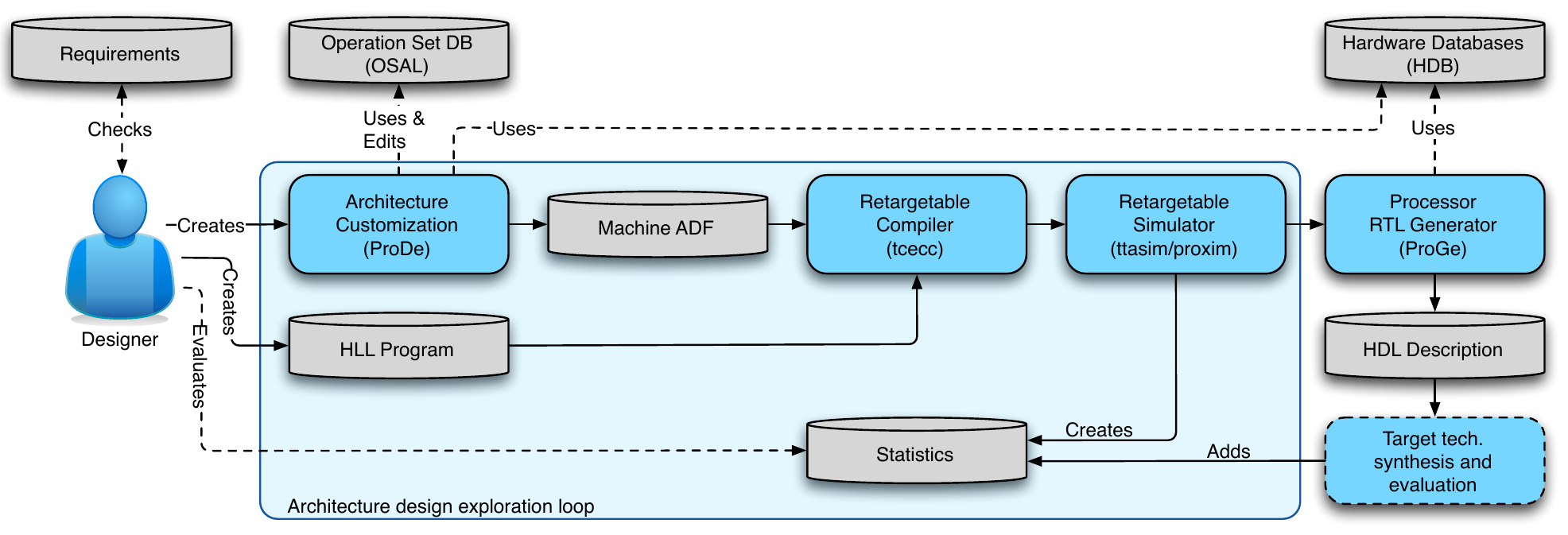
As part of the project we are developing a codesign toolset using TTA as the architecture template. The toolset is called TTA-based Co-design Environment (TCE).
TCE is a toolset for designing application-specific processors (ASP) based on the Transport Triggered Architecture (TTA). The toolset provides a complete co-design flow from C programs down to synthesizable VHDL and parallel program binaries. Processor customization points include the register files, function units, supported operations, and the interconnection network.
TCE has been developed in the Tampere University of Technology since the early 2003.
Further reading: LLVM project blog post about TCE.
Current status (updated on 2012-06)
Features in TCE 1.6:
- Compiler:
- LLVM 3.1 based, Clang as the default frontend
- OpenCL support via the pocl project
- Basic block instruction scheduler (top-down and bottom-up)
- Delay slot filling
- Software bypassing
- Custom operation support
- Parallel TTA assembler
- Software and hardware floating point support
- Basic debugging info support
- Multiple address space support
- Simulator:
- Graphical and command line user interfaces
- Interpretive debugging engine for cycle stepping
- Static compiled engine for fast simulation with basic block granularity (but cycle count accuracy)
- Dynamic compiled engine for improved startup time with fast simulation
- SystemC integration API
- Processor and Program Image Generation:
- Support for generating implementation for the designed processor as VHDL. Experimental support for Verilog.
- Generates bit image of the program (supported formats include the Altera MIF)
- Dictionary-based instruction compression
- Automated generation of the files needed to integrate the core to different FPGA platforms.
- IP-XACT 1.5 support
- Design space exploration:
- Automated, manual and semi-automatic algorithm implementations
- Tools that allow easy modification of the target architecture
- Automated search of the connectivity design space
- Integrated Development Environment tools:
- Graphical user interface (GUI) for editing architecture resources
- GUI for editing operation set definitions